
What the cold brings forth: power, violence, qualities of light
Reflections from the coldest night in January

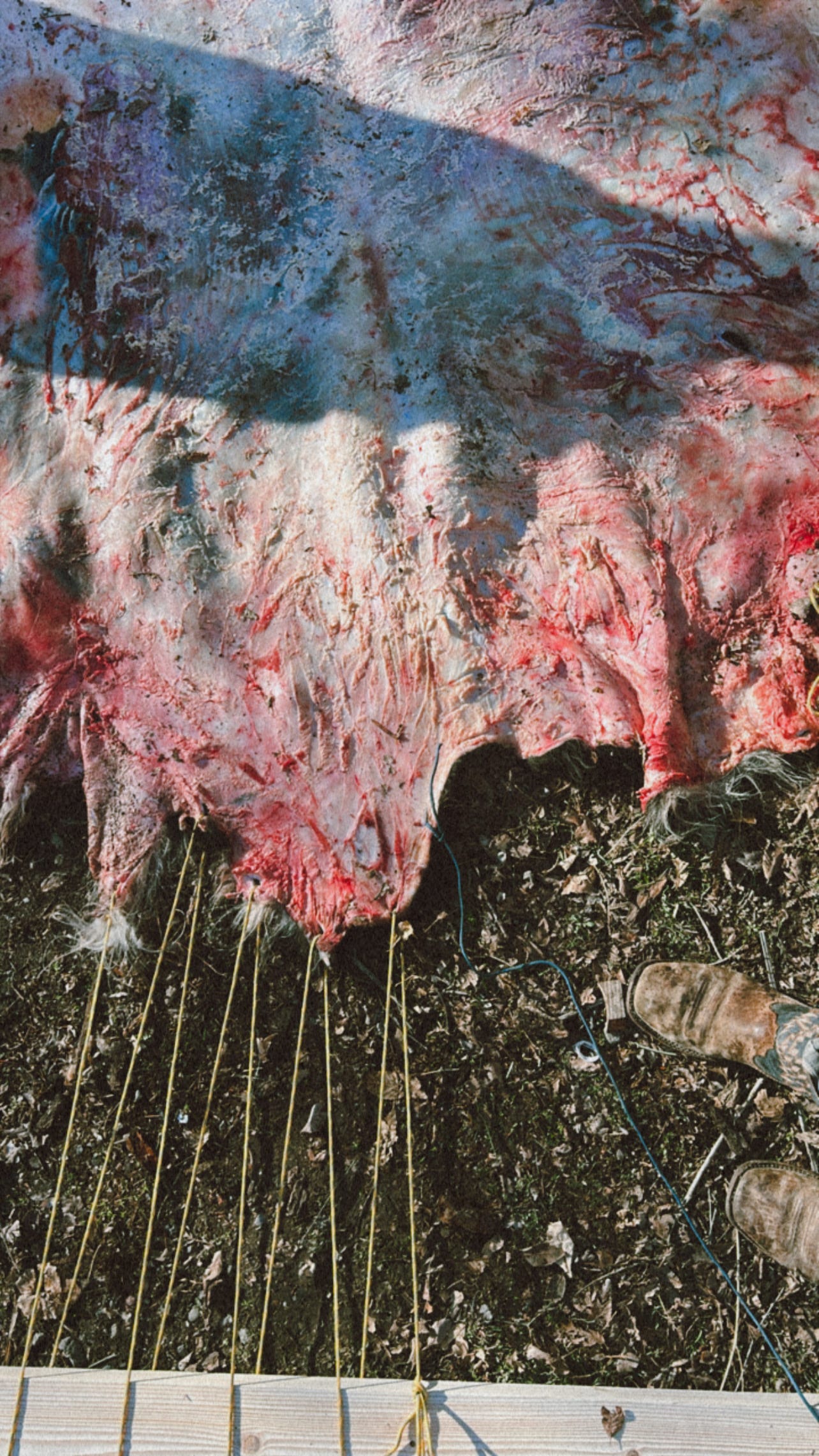

(started mid-January in Paonia, Colorado, publishing early February in central Arizona)
Hello from early morning in my work studio. I am busy sewing holes on sheepskins I’m about to send off to their new owners and listening to the local radio station KNVF. I slept in my work studio the past two nights on the floor, due to the cold that came upon the region. The night before last was especially brutal, with temps hovering around 1 degree Fahrenheit at night.
The thing is, I have spent plenty of times out in cold like this and loved it, especially when I lived off grid in rural New Hampshire and worked at a nordic ski center back between 2011-2013. I would wake to subzero temps living in my uninsulated wooden hand built sauna turned shack, make a fire, and then go skiing to warm up, seeing the sunrise and get my heart moving— things I didn’t realize at the time were prescriptions for good mental and physical health in the winter. I would come back and put my Italian espresso maker on the now hot wood stove with snow melt, have my coffee by a now hot fire, put on nicer clothes for work, and then ski down to the lodge to start working at my job. That job started with making more fires in the downstairs lodge room, upstairs lodge room and waxing shed. It sometimes started with reading the outside temperature and then writing on the message board as people walk in, what color wax they were to use that day on their skis, based on the temperature. Sometimes it meant shoveling snow. Or putting away ski boots that dried by the fire all night. I was one of the few employees at this nordic ski center, run by a family for many years. I was used to pained hands and feet from blistering cold, and had tools to move through it.
Nowadays, I do the cold motions still, but somehow it feels different. Environment is everything. Now I’m living near town, though my airstream home is by a river, spring and beaver dam a mile from downtown proper, and trying to do town things in a town shut down for winter. It’s hard for it to not feel different. It’s hard to connect to the land in the same way when the societal isolation I feel as an adult is so prominent and glaring. I remember thinking when I did those New England winters, that there is no way I’d survive just living like a normal person in that region, in a town with a 9-5 job in a cold apartment alone. It is different that being cold way out on a trail system, where town is a once a week or every other week thing, and life surrounds the rhythm of the land by default, and I got paid to do it. Having a job that is fun and meaningful, where I could connect with all different kinds of people, while living minimally off grid in the woods, was a good mix of social and solitude. Being in a town shut down for winter, living alone, having inconsistent work, being in a town with two exes, feeling the state of the world and how it trickles to me right here in the personal, is a lot different than my innocence way back then. I was younger, had love, hadn’t had my heart broken as much, felt deeply connected to the landscape, was having fun and didn’t feel so lonely.
While I did experience gendered violence back then through how I was treated by my boss who claimed to be a progressive man, I also learned a lot of skills that were never accessible to me growing up. Chainsawing, driving a tractor hauling logs out of the woods, working a wood splitter, using tools, a saw mills, planers. I did this in single digit temperatures outside all day and worked incredibly hard. Hurting my body. I was both given an opening into ‘male skills’ while being told that they were too dangerous for me at the same time because I was a woman. I was told it was ‘special’ for me to get to access them and I better work extra hard to prove my equal worthiness. Back then, while the scene was romantic, the underlying stress to perform both ‘woman’ in constructions of femininity and politeness in the front of the house and then doing the jobs of ‘men’ behind the scenes, being told I need to perform fast and hard like the idea of how a man would or they resent paying me an equal wage, was a lot. I just took it and lived with that stress to perform. I thought, maybe if I just work so hard, they will see me as valuable for me and understand how these things are unfair. It never really worked that way. At the time, I was naive, and didn’t fully realize that this was sexism, until later in life after I had experienced it over and over, and from people very close to me. Over the years I realized how this doesn’t change, and if anything, these kinds of things can get worse. I’ve still struggled with my fair share of this from all genders, but often men, put in unearned positions of power, unwilling to analyze it and assume their time is worth more than mine. It’s often something that people don’t even realize they are doing because they are used to the kind of power they get by default. Or assumption of ability. It’s the worst when it comes from people who claim to be spiritual and evolved but actually perpetuate the same things they claim they are evolved from. It’s almost more insidious this way.
And yet gendered roles are functional for many, and useful at times, not violent by nature per se. I am most curious as to how we decide they are wielded and performed. Violence is something I’ve been thinking a lot about off line and in my immediate personal spheres lately given the state of the world, and in these moments, that word comes to mind. Folks have different ideas about how to define it. I used it to speak to the stress I felt with those experiences put onto me. In these moments, one person would call these kinds of psychological pressures violence, and the words used to enact them violent, and in other cases people would not see it as violent, that only actual physical harm is violent. What is harm and what constitutes real pain is something that is debated heavily in a lot of spheres, and the conclusions we come to based on presumptions we have about the nature of things —within us as humans and outside of us. Often psychological distress is not seen as harm, when physical pain is considered more obviously measurable.
In Emma Marris’ book ‘Wild Souls,’ on pages 25-26, she says:
“Many ethicists focus less on an animal’s intelligence or rationality than on its ability to feel pleasure and, in the fullest sense of the word, suffering. Animal welfare researchers draw a distinction between systems that merely precipitate a reation when a dangerous stimulus is detected and systems that take information about those stimuli into the organism’s conscious mind to be experienced as unpleasant. Only the latter is considered real pain…”
I know folks who only see physical assault as violent in line with the sentiment that Emma Marris outlines above, and with that definition, verbal or physiological abuse is normal, more on the person receiving to take it a certain way than the person enacting. Basic kindness as a baseline is a debatable state of being, with some seeing empathy, compassion, and kindness as actually coddling. It is easy to shift the meaning of words, when the strategic want for power is at play. Philosophers like Jacques Derrida speaks to the inherent violence found in language in works like ‘Deconstruction’ which I read back in college in 2008 while getting a Philosophy degree focusing on postmodernism and globalization theory. While his work can be hard to read whick in some ways is on purpose— and he doesn’t claim to have a destination point, I appreciate the way he speaks to how language allows those who have, wield and abuse power to continue to do so. And yet, those who resist it, may end up using the same words and patterns in that resisting, recreating the same harm, if this language is not looked at as potentially violent in its implications socially, environmentally, from a truly critical lens. Can we really speak here in spaces like this on substack, while the world is reading and watching us, knowing our names, projecting ideas onto us, the govt taking note trying to figure out if you’re ‘in’ or ‘out’ outside of this didatic pattern of throwing violence back and forth?
Violence towards one group of people, whether it is women that men can’t control, or brown folks who are scapegoated for the larger problems of how our fragile society depends on resource extraction, or certain plants that don’t behave the way we want them to, or from activists towards ice, or ice towards brown people, or activists towards cops, or parents towards children that act us, or dogs that chase, or domestic animals we want to go in a box they don’t want to go into….. We impose our will, and must decide in what cases it is ‘right.’ So often people believe wholeheartedly in their violence that it is actually goodness. This is beyond political affiliation, and worthy of analysis. Living in the cold, and my relationship to the work it requires to survive in, reminds me of the complex intersections of violence that trickle out and in from this space. The web flows out, connected to so many pieces that make up any given circumstance. We are meant to be interdependent, and yet, in independence, it is harder for me physically and psychologically. It is for anyone who is trying to do things on the land they would have once done in larger familial units. Is it violent to sell land, or fence land, or rent a place to breathe, to have to stay small in order or not be houseless, to cook alone or pay someone less than someone else based on their gender? Is it violent to expect endless energy from some people, while others are allowed to sell their same vital energy and respected for doing so, sometimes even selling the energy they got for free from someone else? Is it inherently violent to sell anything? To pull it from its animist aliveness and turn it into an object for trade and consumption?
I started reading ‘Wild Souls’1 by Emma Marris an author I loved five years ago when I read her book ‘Rambunctious Gardens,’ which questions the concept of ‘wilderness’ and whether it was an idea worth fighting for. ‘Wild Souls’ focuses on animals and not plants like her previous book and the first chapter gets right to this. It couldn’t be more fitting for this moment, in my personal spheres, and in the global, where people are asking a lot of questions about violence. She speaks to how we treat animals in this way- in some cases there is a perfectly good reason to be violent towards individual or collective groups of animals, because they are either bad, or don’t belong in some way. In some cases we kill lots of one animal to attempt to save another animal that is rare, that we feel belongs, and is more worthy of existence. I find it most fascinating and disturbing, how any group of humans can convince themselves that killing or harming another group of life is justifiable. Whether it is punishment, or retaliation, or sensing that someone doesn’t belong. Or that the other group is evil and we know that for certain. You’d be surprised how many scientific articles refer to coyotes and ‘invasive weeds’ as evil or up to no good. Bad. But on the same token, we used to call wildfires bad, and now we are starting to see how fire is actually good, and the ‘devastation’ is actually renewal. Some see killing any animals at all, even though humans are evolved to eat at least some meat, is violent and disturbing. If you’ve ever taken a life of an animal, or seen it done, then you understand how questions came come up around this definition. Is this sacred, or is it evil? Are we harming, or helping? Can one live a life without causing pain or harm? Can you see how this gets to be a tricky moral wormhole? The answer in some ways is that noone can exist without feeling pain or causing it. Violence is a part of life, but when is the line drawn where it is too far?
Was it violent, being told I need to perform like a man or get paid less, or be resented for having to be paid equal? Was it violent to be told by a colleague closer to my age that he should get 70% of a profit in a class we had discussed teaching together, while I do all the work to get sign ups, even though I have been apprenticing to the skill twice as long? Or is it the way of things I must accept? Is it violent to kill rats taking over your home? Is it violent to spank a child? To punish a dog who killed a chicken with physical punishment? Just questions, to think about. I am not here to tell you where to put this line, but to consider its strategic flexibility.
I say all this and I have people who show up in my life without expectation, at different moments, and for that I am grateful. I’m not 25 anymore, and certainly the will to ‘prove’ my toughness is less, and yet the terrain is no longer unfamiliar. I’m not afraid of the cold, but what it brings up for me is spiritual and psychological discomfort. I cannot run away from myself, my past experiences, nor the state of the world and the implications of speaking my mind, or of being on my own in a lot of ways. The encountering of the element, waking up to a cold house and a frozen over river, is somehow deeply embedded in something familiar in my Nordic ancestored bones, and yet, something else tells me it isn’t right. There should be something else happening. And yet my resistance to what ‘is’ may be just keeping me right here. Recently I slept next to some friends spontaneously in a platonic way, and my dreams and nervous system felt totally different. Even if in the same room, the feeling of togetherness changed the way I slept. Sleeping in my friend’s house with others scattered in the building, or at sheep camp in November with friends all in their truck beds around me, my body recognized something different. At my abode on the river, there is a stark existential aloneness, aside from the land spirits, and perhaps the spirits of the couple murdered on the other end of the property many years ago lingering around — and I think my body knows that it isn’t the way it is supposed to happen. Is it violent to be severed from the togetherness, with life, and other humans, and the clear understanding and compass for knowing violence from not, the place where it is fitting and the place where it is forbidden? How is it that we are so lost and disconnected from a compass that tells us clearly so? It could be a fall from God, or it could be a fall from the land gods, or maybe something greater entirely that we no longer know how to name or sense in ourselves. Distinguishing what is real and isn’t has become more difficult as any group of people could convince themselves of a need for violation, and as we all are struggling to belong, its easy for folks to jump onto a bandwagon. With the avent of AI, its more important than ever to take time to tune inside ourselves and feel what is ours, what isn’t. What is social, what is possibly sturdy.

I haven’t written on substack in awhile and I’ve been trying to understand why. I’ve done a lot of vulnerable sharing on here, and a lot of it is for me, not for anyone else, ultimately. But people read it, people around me, in my community, in communities beyond, family members and that vulnerability is an opportunity for people to pass judgement, or assume things about you. I feel paralyzed by people knowing me and assuming that reading my work is an invitation closer. Its funny because, don’t we write on here, with the hopes of more ears and eyes and connection? With writing as an interface for communication and dialogue? In my every day waking world, I feel pretty guarded and for good reason. I don’t want to connect deeply with everyone, and I don’t like the pressure to do so. I don’t like the expectation of my energy to be given, especially to certain people. I’m more willing with some people, but at the end of the day, I’m tired. Of holding, giving, pouring, and feeling like my basic needs are barely met myself. And then being told, I just need to rely on a man to take care of me and then I’d have less stress, in so many words. And at the same time, new wave feminism rejects this and says I must participate in capitalism the same way as men but be ok getting paid less, and still be willing to raise a child and keep a home on top of that. How the heck do people actually do it? I think we live in a world where certain people are emboldened to say to do things that wouldn’t have been socially acceptable 10-20 years ago given when is president, and now that they are ‘allowed’ to do or say certain things without repercussion, they will do so. And I think that is going to get worse. People tell me that I need to think about my future, when all I do is think about how to pay my bills while doing the work which is important to me inspiring people to consider our future as humans with the land. It’s frustrating to be trying so hard, and people still tell me I’m not doing enough, or the right things, while other folks tell me I changed their life with my podcast, teaching, past writing. I’m so easily affected by the things people tell me, I am distant yet empathetic, guarded yet sensitive, and it’s hard for me to not internalize what people say to me. And yet, I often can look at things from a birds eye and deep waters view while also feeling it deeply in the moment. All this said, reasons for writing less, of which I maybe have addressed similarly on here at other moments of quiet, are hard to fully pinpoint. Obviously we live in a world where it is increasingly risky to say how you really feel, from so many vantage points. I am curious to potentially pour myself in the future into more underground projects, where no one knows my name, and I could speak a truth that isn’t attached to me as a person or who I am perceived as publicly. It isn’t safe to speak to the truth of things, and I’m not just talking about the powers that want to control our minds in a more obvious way reacting, but anyone that feels threatened by thoughts and feelings not fitting into a prescribed way of thinking about things.
The pressure to perform online, to constantly be giving ‘content’ in the newest fad way, is exhausting when I’m already exhausted. From being taken from, from my own free will giving without knowing how to always draw a line. I gave free information about plants for years on social media and in a fancy email newsletter, a free podcast for years with little advertising, and it ultimately hasn’t given back to me in a way I’ve needed to support my work blooming. YET. The reality is, the world as we know it currently, is a vampire unless you protect yourself and its your job to do so. It sucks that we have to protect from others ‘violation’ and the inherent violence from a monster that can’t stop eating no matter how much it eats. Never satisfied. AI steals your hard earned work, and regurgitates it to Amazon books that people gullibly and gladly buy. I don’t want my words and art stolen by AI. Or anyone. And yet, we all influence one another. And yet here we are sharing into the universe that could take from us, and we must accept that violence is sometimes inevitable, like a river re-routing in a flood basin, or a fire taking out old growth forest. When you put out seeds into the wind, they will go anywhere and and in many forms and you have to accept that it is something you cannot control. But, for corporations to make money off of your mere existence, is just pure siphoning. Are we all just siphoning to survive? How do we decide our moral compass in times of stress and pressure, of the ways we define violence and balance, right and wrong, human nature and not?

After writing my last piece on Mourning Motherhood, I felt like curling in for a bit. It is uncomfortable for me to admit aspects of myself. And yet, I have found I am treated subtly different after writing that piece, because people read this work. Growing up feeling gender neutral, and i’m not even needing to to attach words to it- like nonbinary or queer these days, but just gender amorphous, the idea of being a ‘breeder’ felt extremely uncomfortable. Perhaps it is how gender was constructed around me, the ‘violence’ I felt I saw in how these roles were played out, not that roles existed, but how they existed. How my mother had so much on her plate providing for the family financially AND being all the mother and housewife things and how I couldn’t imagine trying to do this in this way and the environment in which it happened. Or perhaps it was being in the south, and the sturdiness that folks held onto limiting beliefs, but also tradition they were proud of — their identity in a world that wants to dissolve it. Birds eye view, deep waters view (thanks Mustang Maddy for inspiring me to keep looking from those lenses). Or perhaps it was my medical trauma that caused me to feel unsafe in my body so many places and in so many situations, without much empathy from people especially men and not knowing how to feel certain about anything because I am never sure I know what safety actually is. For my whole life being told I need to be less sensitive, get over it, not have feelings about things that have been done to me against my will, or to not have feelings about things I can tune into from other worlds that the monster has told us to numb, tried to numb. In writing this piece on Mourning Motherhood, revealing one of my parts, I have felt this want to hide. I haven’t reconciled the part of me that doesn’t want to perform that gendered and biological expectation at least in the way that mainstream culture constructs it, and the helplessness and devaluation that gets projected onto mothers— with the part of me that wants to be seen as genderless, as a creature not human at all, as many even more a plant or rock that a person. And yet, there is a part of me that also sees an aspect of myself in a clear gendered role outside of a violent imposition of it, that it could exist in an alternative universe in way that is outside of these reactionary binaries. (and like Derrida says, can we find non-violence in language if we do not consistently critically analyze it and its implications, even in radical spaces that claim to be ‘resisting’?)

When the world feels too much, and the pressures to perform to be safe, to exist, to be alive feel heavy, sometimes it is easier to want to walk out on the rock and identify with them, the beings that have seen so much change and movement, stillness and rebirth. The part of me that desires the role of mother but on an alien planet, and the part of me that desires to be seen as a rock, or tree, or bird dissolves into the reality- sitting by a cold wood stove alone on cold nights by a river grappling with the familiar winter demons: abandonment, self worth, loneliness, the stress of capitalism, the stress of the threat of physical violence, or psychological violence, shame at having to be ‘woman’ in mainstream society to be loved, and not allowed to be ‘rock’ or ‘tree’ or ‘creature’ worthy of love, worthy of a break from violence that may or may not be ‘natural’ to an extent, but the other side of it, which is union. All these things can exist at once. And through all of the complex feelings of stress, I have grace for those who I feel hurt me. And for the ways I hurt myself. And the parts I refuse to look at, and avoid because its uncomfortable and I feel uncomfortable enough most of the time. I have grace and compassion for a culture that is thoroughly convinced that the violence it enacts is justifiable, because the blinders are strong and are hard to take off, because its scary out there. And the old gods might not necessarily be as graceful to us, or nice, or see violence in the same way might in a moment either.
Winter often for me brings up hard feelings. Without love, whats anything worth doing? Without togetherness, consent and art, beauty and curiosity, what are we here for? What is my so-called ‘work’ if embedded in critical tension between it as a means to end for survival in capitalism, and it being aside from that system? Would it look the same without all the pressure of performance? Would the fatigue be the same with the right collaborators and kin? Outside forces can affect our perspectives. The lens from which we see. How we see the thing right in front of us. The light that shines through, or the lack of light, affects what is visible. At every moment it is important to remember that the quality of light affects our vision. Each one of us comes with a lifetime of experiences that are a combination of out choices and things beyond out control, and they affect the light that shines onto our circumstances. Anyone who studies PTSD knows that even the smallest thing can trigger a flashback, and the quality of light can change in an instant.
We MUST have grace for ourselves and those around us whose stories we do not fully know or understand. Even if I cannot extend myself obviously, the guardedness is protecting my empathy that I cannot always show. Empathy for hurt people, a hurt planet. And perhaps, we can’t always be empathetic, and we must have grace for that too. New pathways are incredibly hard to re-carve. We cannot change other people to be what we want them to be. And yet, like any Zen koen will say, the light can also change in an instant, the bamboo hits the floor in just the right way and make the certain sound—it often means letting go of figuring something out, or knowing the perfect formula. Or it often means letting go of what isn’t working, who isn’t serving our best selves even if we care about them and know where their patterns come from. We have a right to expand or contract in any moment we please. The universe does it too. Winter is contracting, the cold shrinks and shrivels, is uncomfortable, harsh, and yet beautiful somehow.
Soon I head to the Sonoran desert for a bit, and other parts of the warmer southwest that bring me joy and shine a different quality of light on my parts. While certainly some could say that it is irresponsible to pay rent on a space while not using it for two months, another would say that if the spirit cannot realign with the greater path, and be reminded of whats most important, than there’s no point in slogging along. It helps me see more clearly, to get out of whats right in front of me. And funny enough, I always was changing my environment in the past. Always on the move. And now that I am seeing the same worlds over and over every day, I realize that staying put doesn’t mean that the right scenario unfolds. It doesn’t mean that you’re suddenly happy and at peace. Especially if not intentionally chosen with solid ground.
This year I really want to remember what it feels like to intentionally choose. There are times that I have in the past, while the thing I choose didn’t choose me. Many times, I choose out of pressure or survival, or things are chosen for me. What does it truly look like to intentionally choose, and have faith that what comes with that choice has some element of unknown, and that I, like anyone, have the tools to face those unknowns? Or may face levels of violence on the way? Is the path not right for me, or is it simply the quality of light informing my perspective?

Subscribe to listen to the Ground Shots Podcast, which I’ve ran since 2017 and with almost 90 episodes, the majority of which are interviews or collaborative conversations with people from all walks of life. Especially focused on intersections of land, people and creative solutions for re-seeing. Your itunes reviews, sharing, and listening, carrying seeds on from my humble starts means much in my wondering about ‘why’ am I doing this.
+++++++++++++++++++++++++++++++++++++++
Sign up for Spring hide tanning classes in-person in Paonia, Colorado
꩜꩜꩜꩜꩜꩜꩜꩜꩜꩜꩜꩜꩜꩜꩜꩜꩜꩜
Bioregional Tannins online class re-play download. Class I taught two years ago on wild tannins you can use in your hide tanning or natural dye practice. You can access for a small fee and watch the class recording. I have reconsidered teaching online again after having lots of big conversations in person lately, this was the last time I have taught or shared in this way online!

circling some of these questions with you, the compulsion to "fight fire with fire," how to be in relationship to harm/how to protect, how to hold my inherent learned violence in the light (not stuff it away in the dark), and always always looking for the way from under or above or somewhere else along the line of either/or
Kelly, Thank you for always asking deep questions, for never accepting the simple answers, and for being honest about what you feel. You shine a unique light in this world. I honor you.